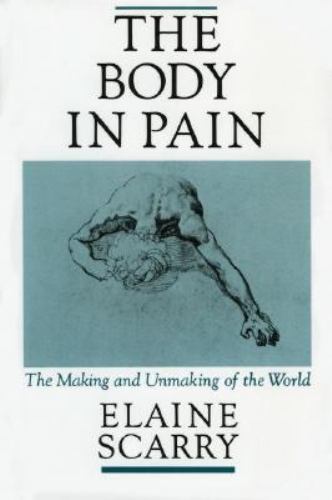
HomeBody in Pain by Elaine Scarry - Making and Unmaking the World 1987 Paperback
Body in Pain by Elaine Scarry - Making and Unmaking the World 1987 Paperback
$
4.22
TitleLeading:TheISBN-13:9780195049961gtin13:9780195049961Genre:Literary Criticism, SciencePublication Year:1987Intended Audience:TradePublisher:Oxford University Press, IncorporatedNumber of Pages:400 PagesLanguage:EnglishItem Length:8.1 inSynopsis:Part philosophical meditation, part cultural critique, this profoundly original work explores the nature of physical suffering. Elaine Scarry bases her study on a wide range of sources: literature and art, medical case histories, documents on torture compiled by Amnesty International, legal transcripts of personal injury trials, and military and strategic writings by such figures as Clausewitz, Churchill, Liddell Hart, and Henry Kissinger. Scarry begins with the fact of pain's inexpressibility. Not only is physical pain difficult to describe in words, it also actively destroys language, reducing sufferers in the most extreme cases to an inarticulate state of cries and moans. Scarry goes on to analyse the political ramifications of deliberately inflicted pain, specifically in the cases of warfare and torture, and she demonstrates how political regimes use the power of physical pain to attack and break down the sufferer's sense of self. Finally she turns to examples of artistic and cultural activity; actions achieved in the face of pain and difficulty., Part philosophical meditation, part cultural critique, The Body in Pain is a profoundly original study that has already stirred excitement in a wide range of intellectual circles. The book is an analysis of physical suffering and its relation to the numerous vocabularies and cultural forces--literary, political, philosophical, medical, religious--that confront it. Elaine Scarry bases her study on a wide range of sources: literature and art, medical case histories, documents on torture compiled by Amnesty International, legal transcripts of personal injury trials, and military and strategic writings by such figures as Clausewitz, Churchill, Liddell Hart, and Kissinger, She weaves these into her discussion with an eloquence, humanity, and insight that recall the writings of Hannah Arendt and Jean-Paul Sartre. Scarry begins with the fact of pain's inexpressibility. Not only is physical pain enormously difficult to describe in words--confronted with it, Virginia Woolf once noted, "language runs dry"--it also actively destroys language, reducing sufferers in the most extreme instances to an inarticulate state of cries and moans. Scarry analyzes the political ramifications of deliberately inflicted pain, specifically in the cases of torture and warfare, and shows how to be fictive. From these actions of "unmaking" Scarry turns finally to the actions of "making"--the examples of artistic and cultural creation that work against pain and the debased uses that are made of it. Challenging and inventive, The Body in Pain is landmark work that promises to spark widespread debate., In this ground-breaking meditation on pain and the literary, philosophical, political, medical, and religious vocabularies used to describe it, Scarry analyzes physical pain within numerous contexts by examining a wide range of original sources ranging from court transcripts to Amnesty International testimony on the effects of torture., The Body in Pain is a profoundly original meditation on the vulnerability of the human body and the literary, political, philosophical, medical, and religious vocabularies used to describe it. Elaine Scarry bases her analysis on a wide array of sources, including literature and art, medical case histories, documents on torture compiled by Amnesty International, and the writings of such figures as Clausewitz, Churchill, and Kissinger. The author begins with the fact of pain's inexpressibility, noting not only the difficulty of describing pain, but its ability to destroy a sufferer's language. She then analyzes the political consequences of deliberately inflicted pain, particularly in cases of war and torture, showing how regimes "unmake" an individual's world in their exercise of power. From the actions that "unmake" the world Scarry turns to a discussion of actions that "make" the world -- the acts of creativity that produce language and cultural artifacts. Book jacket.Book Title:Body in Pain : the Making and Unmaking of the WorldReviews:"A richly original, provocative book which makes one reconsider torture,war, and creativity from a new perspective."--Anthony Storr, Washington PostBook World, "A brilliant and difficult book...Scarry's compassionate linguistics documents how [the] bridge between torturer and victim is cut."--Michael Ignatieff, The New Republic, "I believe this project to be perhaps one of the most significant books on language, philosophy, and literature of the coming years."--Emory Elliott, Princeton University "Stunningly original, enormously important, powerfully written....The beauty of her writing is that she can make us see torture and war as we have never seen them before, read the Bible and Marx as we have never read them before--indeed, see our day-to-day world in a usefully new manner."--Eric J. Cassell, M.D., Cornell Medical Center "One of the most important books I have read this year [1987]."--Judith Fryer, University of Massachusetts "Not for some time have we read a more original book on an announced subject than this review of pain's locations in torture, war and wherever people would do violence to others."--The Christian Century "An extraordinary book: large-spirited, heroically truthful. Anecessarybook."--Susan Sontag "A richly original, provocative book which makes one reconsider torture, war, and creativity from a new perspective."--Anthony Storr,Washington Post Book World "Brilliant, ambitious and controversial...an all-encompassing discourse on creativity, imagination and the distribution of power."--Los Angeles Times Book Review "In its breadth and humaneness of vision, in the density and richness of its prose, above all in the compelling nature of its argument, this is indeed an extraordinary book."--Susan Rubin Suleiman,The New York Times Book Review "A brilliant and difficult book...Scarry's compassionate linguistics documents how [the] bridge between torturer and victim is cut."--Michael Ignatieff,The New Republic "One of the most important books I have read this year."--Judith Fryer,University of Massachusetts "Only by following Scarry step by step may a reader gradually discern the daringly encompassing scope of Scarry's vision on body and pain, making and unmaking. [Her] style of writing is at once profoundly personal and succinctly scholarly."--Religious Studies Review "Scarry has written a dramatic and provocative discourse on the power of pain and man's reaction to it....The flow of the text is fluid and creative; the book is a well-disciplined example of literary thinking."--he Yale Journal of Biology and Medicine "The book is large, ambitious, intricate and alternately illuminating, baffling and irritating....[It] is a brave book, and worth persevering with."--The Times Literary Supplement(London) "An absolutely astonishing achievement...I believe it will change many lives, not by persuasion, but by widening the scope of consciousness. The book itself is a great act of courage, intelligence, and style."--Allen Grossman, Brandeis University, "Brilliant, ambitious and controversial...an all-encompassing discourse on creativity, imagination and the distribution of power."--Los Angeles Times Book Review, "I believe this project to be perhaps one of the most significant books on language, philosophy, and literature of the coming years."--Emory Elliott, Princeton University"Stunningly original, enormously important, powerfully written....The beauty of her writing is that she can make us see torture and war as we have never seen them before, read the Bible and Marx as we have never read them before--indeed, see our day-to-day world in a usefully new manner."--Eric J. Cassell, M.D., Cornell Medical Center"One of the most important books I have read this year [1987]."--Judith Fryer, University of Massachusetts"Not for some time have we read a more original book on an announced subject than this review of pain's locations in torture, war and wherever people would do violence to others."--The Christian Century"An extraordinary book: large-spirited, heroically truthful. A necessary book."--Susan Sontag"A richly original, provocative book which makes one reconsider torture, war, and creativity from a new perspective."--Anthony Storr, Washington Post Book World"Brilliant, ambitious and controversial...an all-encompassing discourse on creativity, imagination and the distribution of power."--Los Angeles Times Book Review"In its breadth and humaneness of vision, in the density and richness of its prose, above all in the compelling nature of its argument, this is indeed an extraordinary book."--Susan Rubin Suleiman, The New York Times Book Review"A brilliant and difficult book...Scarry's compassionate linguistics documents how [the] bridge between torturer and victim is cut."--Michael Ignatieff, The New Republic"One of the most important books I have read this year."--Judith Fryer, University of Massachusetts"Only by following Scarry step by step may a reader gradually discern the daringly encompassing scope of Scarry's vision on body and pain, making and unmaking. [Her] style of writing is at once profoundly personal and succinctly scholarly."--Religious Studies Review"Scarry has written a dramatic and provocative discourse on the power of pain and man's reaction to it....The flow of the text is fluid and creative; the book is a well-disciplined example of literary thinking."--he Yale Journal of Biology and Medicine"The book is large, ambitious, intricate and alternately illuminating, baffling and irritating....[It] is a brave book, and worth persevering with."--The Times Literary Supplement (London)"An absolutely astonishing achievement...I believe it will change many lives, not by persuasion, but by widening the scope of consciousness. The book itself is a great act of courage, intelligence, and style."--Allen Grossman, Brandeis University, "A richly original, provocative book which makes one reconsider torture, war, and creativity from a new perspective."--Anthony Storr, Washington Post Book World, "I believe this project to be perhaps one of the most significant books onlanguage, philosophy, and literature of the coming years."--Emory Elliott,Princeton University, "One of the most important books I have read this year [1987]."--Judith Fryer, University of Massachusetts, "In its breadth and humaneness of vision, in the density and richness of its prose, above all in the compelling nature of its argument, this is indeed an extraordinary book."--Susan Rubin Suleiman, The New York Times Book Review, "I believe this project to be perhaps one of the most significant books on language, philosophy, and literature of the coming years."--Emory Elliott, Princeton University "Stunningly original, enormously important, powerfully written....The beauty of her writing is that she can make us see torture and war as we have never seen them before, read the Bible and Marx as we have never read them before--indeed, see our day-to-day world in a usefully new manner."--Eric J. Cassell, M.D., Cornell Medical Center "One of the most important books I have read this year [1987]."--Judith Fryer, University of Massachusetts "Not for some time have we read a more original book on an announced subject than this review of pain's locations in torture, war and wherever people would do violence to others."--The Christian Century "An extraordinary book: large-spirited, heroically truthful. A necessary book."--Susan Sontag "A richly original, provocative book which makes one reconsider torture, war, and creativity from a new perspective."--Anthony Storr, Washington Post Book World "Brilliant, ambitious and controversial...an all-encompassing discourse on creativity, imagination and the distribution of power."--Los Angeles Times Book Review "In its breadth and humaneness of vision, in the density and richness of its prose, above all in the compelling nature of its argument, this is indeed an extraordinary book."--Susan Rubin Suleiman, The New York Times Book Review "A brilliant and difficult book...Scarry's compassionate linguistics documents how [the] bridge between torturer and victim is cut."--Michael Ignatieff, The New Republic "One of the most important books I have read this year."--Judith Fryer, University of Massachusetts "Only by following Scarry step by step may a reader gradually discern the daringly encompassing scope of Scarry's vision on body and pain, making and unmaking. [Her] style of writing is at once profoundly personal and succinctly scholarly."--Religious Studies Review "Scarry has written a dramatic and provocative discourse on the power of pain and man's reaction to it....The flow of the text is fluid and creative; the book is a well-disciplined example of literary thinking."--he Yale Journal of Biology and Medicine "The book is large, ambitious, intricate and alternately illuminating, baffling and irritating....[It] is a brave book, and worth persevering with."--The Times Literary Supplement (London) "An absolutely astonishing achievement...I believe it will change many lives, not by persuasion, but by widening the scope of consciousness. The book itself is a great act of courage, intelligence, and style."--Allen Grossman, Brandeis University, "I believe this project to be perhaps one of the most significant books on language, philosophy, and literature of the coming years."--Emory Elliott, Princeton University, "I believe this project to be perhaps one of the most significant books on language, philosophy, and literature of the coming years."--Emory Elliott, Princeton University"Stunningly original, enormously important, powerfully written....The beauty of her writing is that she can make us see torture and war as we have never seen them before, read the Bible and Marx as we have never read them before--indeed, see our day-to-day world in a usefully new manner."--Eric J. Cassell, M.D., Cornell Medical Center"One of the most important books I have read this year [1987]."--Judith Fryer, University of Massachusetts"Not for some time have we read a more original book on an announced subject than this review of pain's locations in torture, war and wherever people would do violence to others."--The Christian Century"An extraordinary book: large-spirited, heroically truthful. A necessary book."--Susan Sontag"A richly original, provocative book which makes one reconsider torture, war, and creativity from a new perspective."--Anthony Storr, Washington Post Book World"Brilliant, ambitious and controversial...an all-encompassing discourse on creativity, imagination and the distribution of power."--Los Angeles Times Book Review"In its breadth and humaneness of vision, in the density and richness of its prose, above all in the compelling nature of its argument, this is indeed an extraordinary book."--Susan Rubin Suleiman, The New York Times Book Review"A brilliant and difficult book...Scarry's compassionate linguistics documents how [the] bridge between torturer and victim is cut."--Michael Ignatieff, The New Republic"One of the most important books I have read this year."--Judith Fryer, University of Massachusetts"Only by following Scarry step by step may a reader gradually discern the daringly encompassing scope of Scarry's vision on body and pain, making and unmaking. [Her] style of writing is at once profoundly personal and succinctly scholarly."--Religious Studies Review"Scarry has written a dramatic and provocative discourse on the power of pain and man's reaction to it....The flow of the text is fluid and creative; the book is a well-disciplined example of literary thinking."--he Yale Journal of Biology and Medicine"The book is large, ambitious, intricate and alternately illuminating, baffling and irritating....[It] is a brave book, and worth persevering with."--The Times Literary Supplement (London)"An absolutely astonishing achievement...I believe it will change many lives, not by persuasion, but by widening the scope of consciousness. The book itself is a great act of courage, intelligence, and style."--Allen Grossman, Brandeis University"Excellent, important book."--Kathryn McMahon, California State University, Long Beach"Perfect choice for main text."--F. Tyler Stevens, Johns Hopkins University, "Not for some time have we read a more original book on an announced subject than this review of pain's locations in torture, war and wherever people would do violence to others."--The Christian Century, "Stunningly original, enormously important, powerfully written....The beauty of her writing is that she can make us see torture and war as we have never seen them before, read the Bible and Marx as we have never read them before--indeed, see our day-to-day world in a usefully newmanner."--Eric J. Cassell, M.D., Cornell Medical CenterISBN-10:0195049969Illustrator:YesAuthor:Elaine ScarryFormat:Trade PaperbackItem Height:0.7 inDewey Edition:19Item Weight:10.5 OzItem Width:5.4 inLCCN:85-015585LC Classification Number:BF515brand:Oxford University Press, IncorporatedTopic:Life Sciences / Human Anatomy & Physiology, Semiotics & TheoryDewey Decimal:128
This book is a profound exploration of how pain shapes human experience and society. Scarry’s insights into suffering, language, and power are both unsettling and illuminating. The writing is dense but rewarding, offering a fresh perspective on politics, war, and creativity. A must-read for anyone interested in philosophy, ethics, or the human condition. Thought-provoking and deeply moving.

This book is a profound exploration of how pain shapes human experience and society. Scarry’s insights into suffering, language, and power are both unsettling and illuminating. The writing is dense but rewarding, offering a fresh perspective on politics, war, and creativity. A must-read for anyone interested in philosophy, ethics, or the human condition. Thought-provoking and deeply moving.